Directing movement · Video · Physics
The End of the Plastic Era
How to make AI video actually move — not just strike poses.
We've all been there. You write a lyrical prompt for Runway or Kling — something like "a woman leaps gracefully over a rock". And what do you get? A mutant that hovers in mid-air, loses a leg along the way and pops up on the other side of the frame.
Why does this happen? Because we treat video models like image generators. We describe what the movement looks like, instead of explaining how it happens. Here are five principles that will make your prompts cinematic, fluid and far more human.
Think in chains
Don't write "she raises her arm". Ask yourself — what made the arm rise? Real movement is a chain reaction.
The movement starts in the pelvis, climbs the spine, the shoulder is swept along, the elbow trails behind, and the fingers arrive last. This is always true — in dance, and when someone simply turns round because something fell behind them.
The time between the frames
Movement has a life cycle.
You can't just "jump". Let the character's body prepare, shift its weight, push off the floor, hang in the air, and land with the knees absorbing the energy.
Without anticipation and recovery, it looks like a cardboard puppet jerked about on a string.
Let movement change the space
A character who can do amazing things but stays rooted to the exact same spot isn't a scene — it's a screensaver.
Give the movement a path. Where did the character start? Where did she end up? What changed in the space because of what she did? Good movement needs continuity across the frame.
This is what the preparation looks like. Twelve moments inside a single movement phrase, marked out in advance — each one starting exactly where the previous one ended. It's a storyboard for a thirty-second dance in one take, and every principle above is in it before a single line of prompt was written.
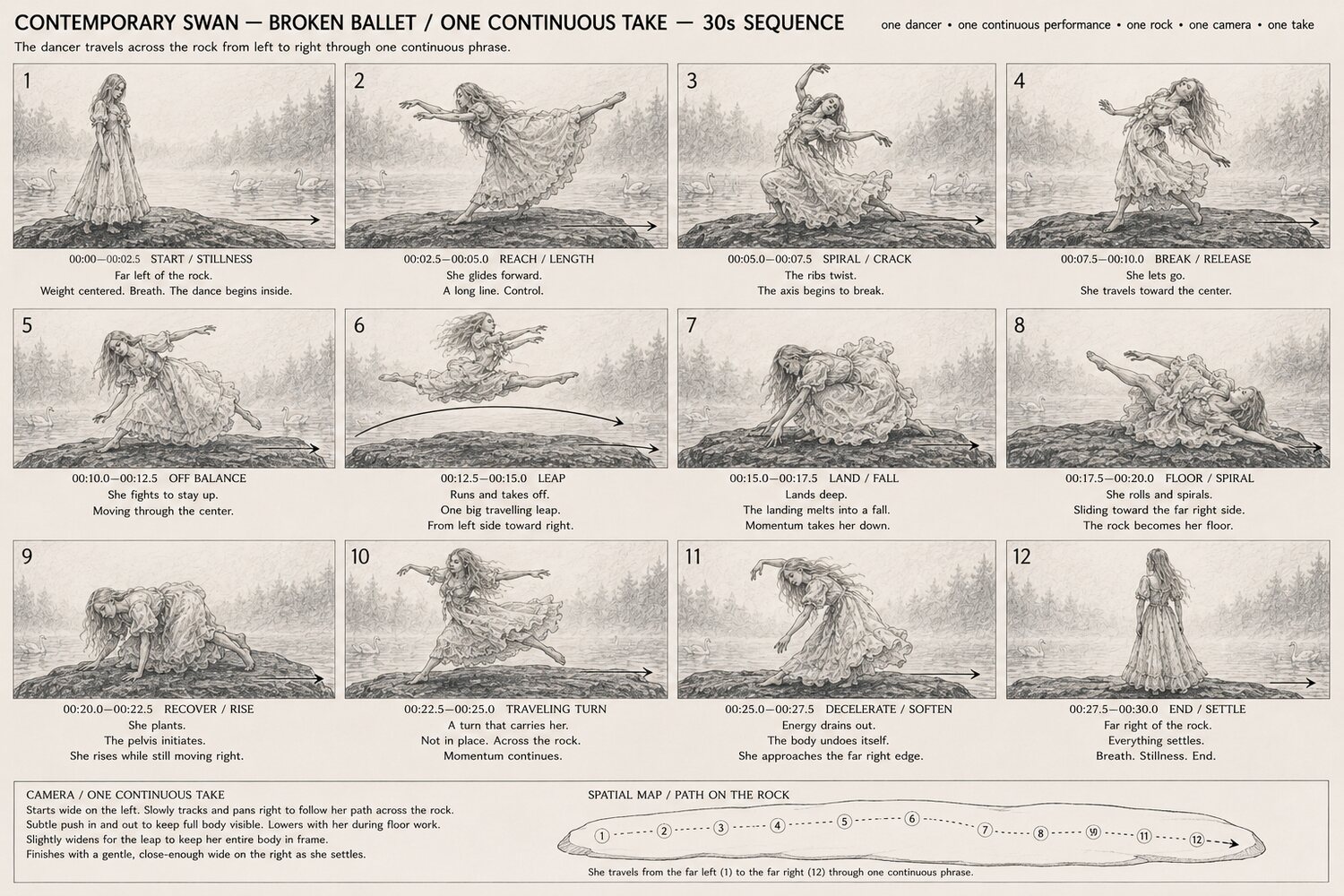
And here's what came out of it — 30 seconds, one take, no cuts
Emotion is a movement mechanism
It's easy to write She looks scared, but emotion isn't a sticker you slap on a face.
Think about what fear does to the body: does the breath stop? Do the shoulders stiffen? Does the weight pull back? An inner state translated into movement quality will always beat another exaggerated facial expression.
The iron rules
You have to tell AI engines the obvious, or they forget the laws of gravity.
If she moves right, the audience has to watch her shift her weight and walk there.
Don't write poses. Write forces, timing and reaction.